English
- English
- Español
- Português
- русский
- Français
- 日本語
- Deutsch
- tiếng Việt
- Italiano
- Nederlands
- ภาษาไทย
- Polski
- 한국어
- Svenska
- magyar
- Malay
- বাংলা ভাষার
- Dansk
- Suomi
- हिन्दी
- Pilipino
- Türkçe
- Gaeilge
- العربية
- Indonesia
- Norsk
- تمل
- český
- ελληνικά
- український
- Javanese
- فارسی
- தமிழ்
- తెలుగు
- नेपाली
- Burmese
- български
- ລາວ
- Latine
- Қазақша
- Euskal
- Azərbaycan
- Slovenský jazyk
- Македонски
- Lietuvos
- Eesti Keel
- Română
- Slovenski
- मराठी
- Srpski језик

Epoxy Resin Cast Dry-Type Transformers: What Exactly are They? What Do They Do?
I. What is an Epoxy Resin Cast Dry-Type Transformer?
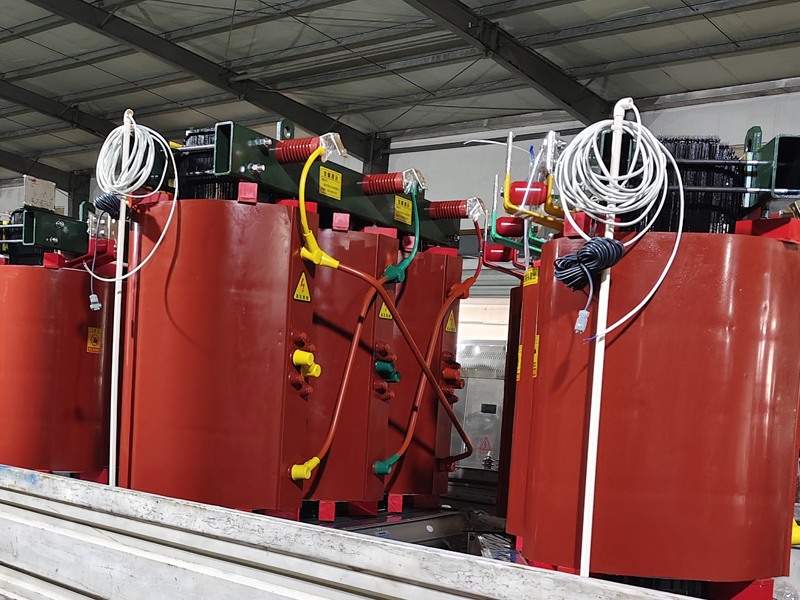
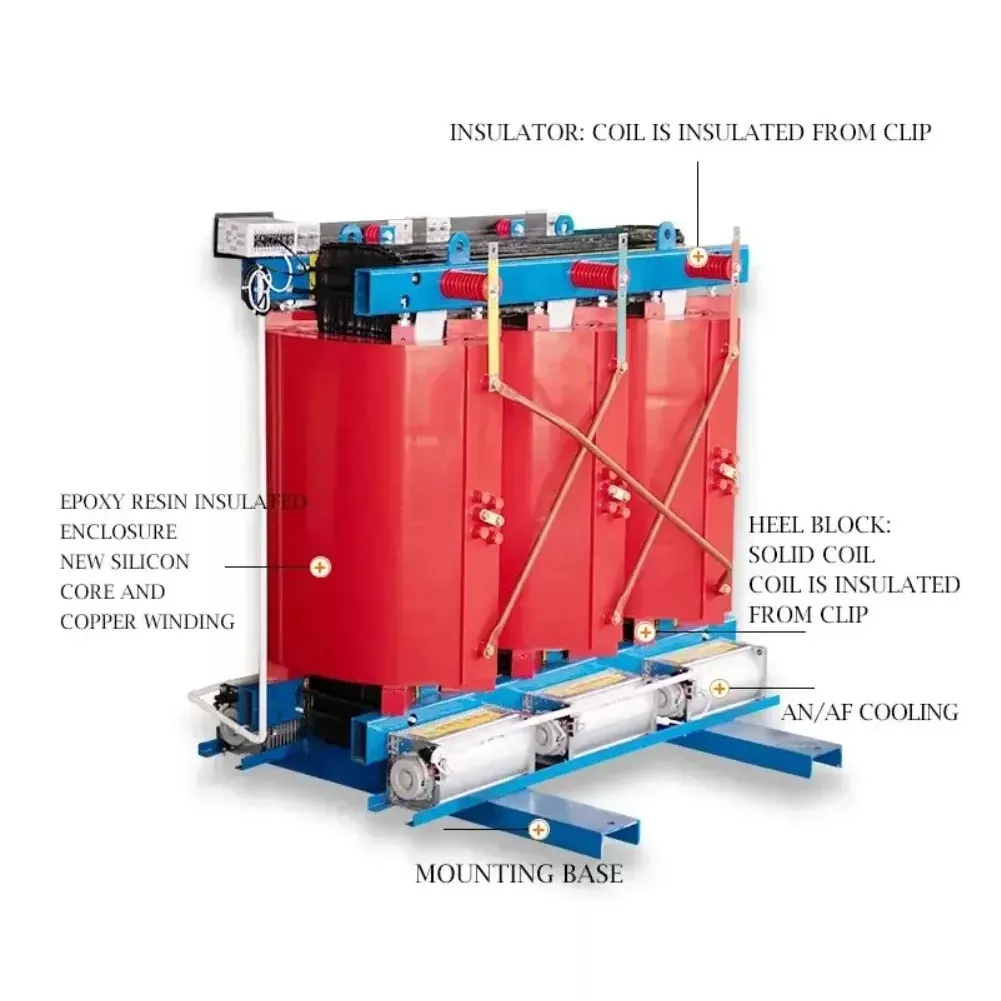
Epoxy resin dry-type transformers use epoxy resin as the insulating material. The high and low voltage windings are wound with copper tape (foil), and epoxy resin is poured and solidified in a vacuum to form a high-strength fiberglass structure. The insulation grades are F and H. Dry-type transformers rely on air convection or forced air cooling for heat dissipation and do not have transformer oil.
Due to its fireproof, explosion-proof and maintenance-free properties, it is widely used in urban subways, high-rise buildings, airports, hospitals, commercial centers and other places with high fire and safety requirements.
II. Process Characteristics of Epoxy Resin Cast Dry-Type Transformers
1. Winding casting molding: The high and low voltage winding are cast with epoxy resin mixture in a vacuum state, and form a dense and solid whole after solidification.
2. Insulation system: It mainly uses epoxy resin as the main insulation and glass fiber as the reinforcing material. It does not require insulating oil and is a solid insulation equipment.
3. Cooling method: usually AN (natural air cooling) or AF (forced air cooling). Equipped with a temperature controller and an axial flow fan, the fan can be started and stopped automatically according to the load temperature. Some products allow short-term overload operation.
III. The Main Advantages and Disadvantages of Epoxy Resin Cast Dry-Type Transformers
Advantages:
1. High Safety and Environmental Friendliness
- Fire and explosion-proof: Epoxy resin itself is a flame-retardant, flame-retardant and self-extinguishing material, which fundamentally eliminates the risk of fire and explosion.
- Pollution-free: Does not contain any insulating oil, eliminating the possibility of oil leakage contaminating soil and water sources. It is very clean.
2. Excellent electrical and mechanical properties
- High insulation strength: The cured epoxy resin forms a dense insulation layer with good insulation performance and strong lightning impact resistance.
- Strong short-circuit resistance: The coil is solidified into a high-strength rigid whole with extremely high mechanical strength and can withstand the huge electrodynamic impact generated when a sudden short circuit occurs.
3. Excellent environmental adaptability
- Moisture-proof and dust-proof: The sealed resin layer can effectively isolate moisture, dust and corrosive gases, and can even operate normally in an environment with 100% humidity.
- Low maintenance cost: No preheating is required before operation, and no drying treatment is required after shutdown. Daily maintenance workload is minimal.
4. High efficiency, energy saving and compact design
- Low loss: By optimizing the iron core (such as using high-quality silicon steel sheets) and winding design, no-load and load losses are very low, and the energy saving effect is significant.
- Small size and light weight: Thanks to the high insulation efficiency of epoxy resin, its size and weight are much smaller than oil-immersed transformers of the same capacity, saving installation space and civil construction costs.
- Low noise: Using advanced technology and materials, the operation noise is low, suitable for hospitals, residences, etc. that are sensitive to noise.
Disadvantages:
- Temperature resistance is relatively limited: commonly used insulation grades are F (155℃) or H (180℃), long-term operating temperatures are usually limited to around 120℃~140℃, and the overload ability is not as good as that of oil-immersed type.
- Risk of partial discharge and cracking: If the pouring process is not strictly controlled (such as bubbles and uneven mixing), partial discharge may easily occur; under extreme cold and hot changes or mechanical stress, epoxy resin may have a risk of cracking.
- High cost: The initial acquisition cost is usually higher than that of oil-immersed transformers of the same capacity.
IV. Maintenance and Common Faults of Epoxy Resin Cast Dry-Type Transformers
- Daily key points: Pay attention to appearance (cracks, discharge traces), temperature (temperature control/hot spots), and abnormal noise; keep insulators, winding surfaces and air ducts clean to prevent dust accumulation from affecting heat dissipation and insulation.
- Regular inspection/testing: insulation resistance, DC resistance, AC withstand voltage, partial discharge, etc.; fastener and grounding inspection are also critical.
Typical Issues:
- Winding Overheating: Often related to overload, poor ventilation, or aging; may manifest as discoloration of the epoxy, burning smell, or localized overheating.
- Partial Discharge: Can originate from damp/damaged insulation, poor leads/grounding, etc., and accelerates aging over time.
- Unusual Noises/Vibrations: May be associated with core clamping issues, loose fasteners, load harmonics, resonance, etc.
V. Common Technical Parameters of Epoxy Resin Cast Dry-Type Transformers
The following are some common technical parameter ranges for epoxy resin cast dry-type transformers, and the specific values will vary depending on the model and manufacturer:
|
Parameter Category |
Typical Range/Description |
|
Rated Capacity |
Usually ranges from 30kVA to 5000kVA, or even higher |
|
Voltage Levels |
Common high-voltage levels include 6kV, 10kV, 20kV, 35kV, etc. |
|
Insulation Class |
Class F (maximum allowable temperature 155°C), H class cooling method |
|
Cooling Method |
Air natural cooling (AN) / Forced air cooling (AF) |
|
Protection Level |
Enclosure typically reaches IP20 to IP44 |
Our company has epoxy resin cast dry-type transformers available for selection.
VI. Main Application Areas of Epoxy Resin Cast Dry-Type Transformers
Epoxy resin cast dry-type transformers are particularly suitable for the following places with high safety and environmental requirements:
Related News
- Start by Choosing the Right JXF
- SG(B)10-10KV environmentally friendly dry-type transformer: How to deliver safe and green answers under non-encapsulated structure?
- What are the hazards of transformer overload operation? How to carry out real-time load monitoring?
- How can oil immersed transformers achieve future green development in the context of "dual carbon"?
- What does the internal structure of a dry-type transformer look like when disassembled?
- How to choose between power cabinet and lighting distribution box?
Leave me a message