English
- English
- Español
- Português
- русский
- Français
- 日本語
- Deutsch
- tiếng Việt
- Italiano
- Nederlands
- ภาษาไทย
- Polski
- 한국어
- Svenska
- magyar
- Malay
- বাংলা ভাষার
- Dansk
- Suomi
- हिन्दी
- Pilipino
- Türkçe
- Gaeilge
- العربية
- Indonesia
- Norsk
- تمل
- český
- ελληνικά
- український
- Javanese
- فارسی
- தமிழ்
- తెలుగు
- नेपाली
- Burmese
- български
- ລາວ
- Latine
- Қазақша
- Euskal
- Azərbaycan
- Slovenský jazyk
- Македонски
- Lietuvos
- Eesti Keel
- Română
- Slovenski
- मराठी
- Srpski језик

What does the internal structure of a dry-type transformer look like when disassembled?
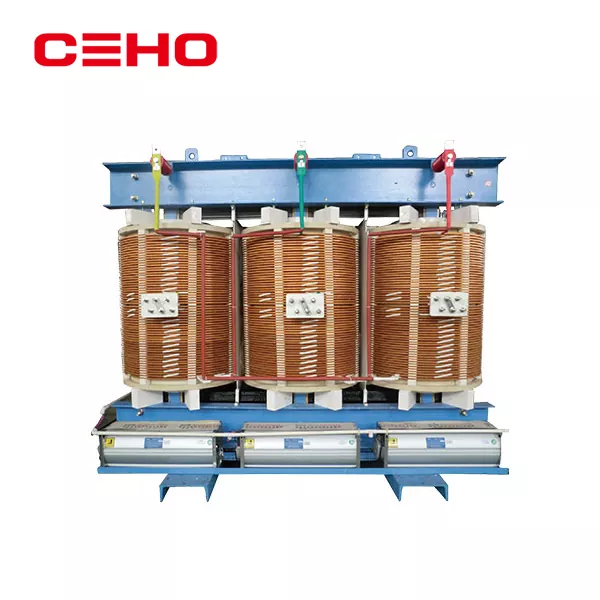
Many people have seen an oil-immersed transformer, and the first reaction in their mind is "there is a big oil tank with coils soaked in it." But dry-type transformers are different - they do not contain oil, the core and windings are basically "exposed" in the air, and they rely on solid insulation and air cooling to take away the heat. If you really open the casing and look around, you will see that the inside is actually very regular: there is an iron core in the middle, with a low-voltage coil inside, and a high-voltage coil outside. The top and bottom are tightened with clamps. Next to it are the temperature control, fan, tap piece and external copper bar.
Let's talk about it in the order of "from outside to inside, from seeing to dismantling".
I. Remove the outer casing first: what you see is the “body” instead of the fuel tank.
Dry-type transformers have no oil conservators, no radiator oil pipes, and no gas relays. The SCB series in common power distribution rooms has a steel plate or stainless steel protective cabinet on the outside, an access door on the front, and shutters on the side for ventilation; small or open installations may only have a simple shield or even no casing.
The normal sequence for external disassembly and inspection is:
1. All high-voltage and low-voltage sides shall be powered off, listed, and inspected, and cables and windings shall be discharged if necessary;
2. Remove the high-voltage cables and low-voltage busbars, and mark the phase and neutral points;
3. Remove the temperature control wire, fan wire, and shell bolts, and remove the panel or the entire side panel;
4. Expose the entire core winding before inspecting the inside.
Reminder: 10kV/0.4kV dry transformer is a high-voltage equipment, and the resin cast coil is heavy and brittle. Individuals should not "take it apart and play" by themselves. For daily inspection, just open the cabinet door to check the appearance and clean the dust; if it really needs to be disassembled, it must be done by the manufacturer or electrical maintenance unit.
II. In the middle: silicon steel core, responsible for "moving the magnetic field"
The most noticeable thing after opening is the gray metal body, which is the iron core. It is made up of many thin silicon steel sheets. Cold-rolled oriented silicon steel sheets are commonly used. The sheet thickness is about 0.2~0.35mm. The sheets are coated with insulating paint to reduce eddy current heating.
Three-phase coherent changes are mostly "three pillars and two yokes":
- The three vertical pillars in the middle are called core pillars, and the coils are placed on them;
- The up and down horizontal connection is called an iron yoke, which closes the magnetic circuit of the three columns into a ring.
Laminations often use 45° full bevel joints or stepped joints to reduce magnetic field lines and reduce no-load losses and noise. The outside of the iron core is clamped with upper and lower clamps, pull plates, and insulating pads. It cannot be loose enough to cause buzzing during operation, nor can it damage the piece by hard prying.
The iron core must be reliably grounded at a single point - failure to ground may produce floating potential discharge, and multiple grounding points may produce circulating current and heat, so this grounding piece should be paid attention to during maintenance.
III. Set on the iron core: low voltage inside, high voltage outside
The core of the dry transformer is two sets of coils, collectively called windings. Simple understanding: the high-voltage side has many turns and thin wires; the low-voltage side has few turns, large current and thick conductors.
The layout rule is generally that they are concentrically placed on the iron core pillars:
- The low-voltage winding is located closer to the inside: Because low-voltage insulation requirements are relatively low, being closer to the core can reduce the overall size; common copper or aluminum foil "foil-type" winding, with one layer of almost one turn, has an axial air duct, and is good for heat dissipation and short-circuit resistance under high current.
- The high-voltage winding is on the outside: the common layer type, segmented cylindrical type or continuous type, wound with flat copper wire, and the whole is vacuum-cast with epoxy resin; tap taps are left outside, making voltage adjustment convenient and safe.
- Place insulating cylinders, end rings, and spacers between high and low voltages to ensure electrical distance and form upper and lower air ducts.
If you see dark resin on the surface of the coil and it looks like a solid hard shell when knocked, it is probably an SCB type epoxy casting type; if you see light-colored insulating paper, paint-impregnated, and no thick resin shell, it may be an SG/SGB type VPI impregnated or non-encapsulated type.
IV. Resin “armor”: both insulation and dustproof depend on it
Dry type does not rely on oil insulation, but mainly relies on air + solid insulation. Epoxy cast winding is equivalent to putting a layer of sealed armor on the copper wire: moisture-proof, dust-proof, creepage resistant, and high mechanical strength. A PT100 temperature sensor is also buried inside and is led to the temperature control box; the low-voltage foil winding often buries the sensor at a hot spot to measure the "real temperature of the coil" rather than just the air temperature.
The non-encapsulated impregnated type uses Nomex paper, fiberglass, insulating paint, etc. The heat resistance level can reach F/H level or even higher. It has better heat dissipation but is not as moisture-proof and dustproof as the cast type.
V. Top and sides: taps, leads, busbars
Continue to "take it apart and see":
- High-voltage tap piece/tap terminal: Pull out several joints of the high-voltage coil, and use a connecting piece or tap changer to change the number of turns. Commonly used are ±2×2.5%, which is used for fine-tuning when the grid voltage is high or low. Dry-type transformers are mostly off-load taps, and a power outage is required to adjust the gears.
- High-voltage lead: Lead from the head of the cast coil, with an insulating sheath or sleeve, and connected to the incoming line side; the three-phase star/delta connection method is different, and the top connection copper rod or insulated connecting rod will also be different.
- Low-voltage outlet wires: Large-capacity commonly used copper bars, A/B/C/N phase-separated leads, directly into the low-voltage cabinet; when disassembling, mark the phase sequence first, and wrap the neutral and phase wires separately.
- Iron core grounding piece: Usually near the clamp, a single piece is led to the grounding terminal. Check for looseness, corrosion, and repeated grounding.
VI. Bottom and back: fan, temperature control, base
There are two types of dry heat dissipation:
• AN natural air cooling: relies on convection on the coil surface and upper and lower air ducts, commonly used in small capacities and light loads;
• AF forced air cooling: A cross-flow or axial flow fan is installed at the bottom to blow air upward; the thermostat automatically starts and stops according to the winding temperature, and it will alarm if the temperature is over and trip if it reaches a higher temperature.
Open the shell and you can see:
• Temperature control box/temperature controller, connected to PT100;
• Fan power supply and start/stop relay;
• Base channel steel and anchor bolts;
• Upper and lower clamps, pull screws, insulators, fixed angle steel.
Not all dry transformers have fans. Many converters below 1000kVA can also operate with natural cooling. When full load or capacity is increased, fans are relied on to further increase the load capacity.
VII. If you really want to "disassemble and view" what to look at?
When professionals perform maintenance or return to the factory for disassembly, the focus is not to break the resin into pieces, but to determine the condition first:
1. Check the outside of the coil for cracks, discharge marks, discoloration, and end expansion;
2. Check the iron core to see if the silicon steel sheet is bruised or rusted, and whether the clamps are loose;
3. Use a vacuum cleaner to clean the dust; do not blow it with compressed air to avoid secondary adhesion of dust;
4. Measure insulation resistance, DC resistance, transformation ratio, withstand voltage, and partial discharge if necessary;
5. Remove the busbar - remove the casing - remove the fan temperature control - and then check the windings and clamps. The resin castings are usually replaced as a whole, and are not "rewinded" as frequently as oil changes.
Another note on waste recycling: epoxy resin must be broken and sorted, and copper foil/copper wire, silicon steel sheet, and steel plate casing must be processed separately and cannot be thrown away as ordinary garbage.
VIII. Summary
When the dry-type transformer is disassembled, it is "an iron core made of stacked silicon steel sheets as the magnetic circuit, with low-voltage foil winding on the inside and high-voltage epoxy coil on the outside as the circuit. The clamps are tightened, the insulating cylinder is air-insulated, the tap is adjusted, the copper discharge line is added, and the temperature control and fan are added to take away the heat." There is no oil or oil tank, and the structure is much more intuitive than that of oil. However, the high-voltage live parts and resin coils are very "squeamish". You can do it, but you must follow the procedures for power outage, power inspection, discharge, and tagging.
Related News
- Start by Choosing the Right JXF
- SG(B)10-10KV environmentally friendly dry-type transformer: How to deliver safe and green answers under non-encapsulated structure?
- What are the hazards of transformer overload operation? How to carry out real-time load monitoring?
- How can oil immersed transformers achieve future green development in the context of "dual carbon"?
- How to choose between power cabinet and lighting distribution box?
- Why is the XL-21 power distribution cabinet the first choice for power distribution in industrial workshops?
Leave me a message
New Products